
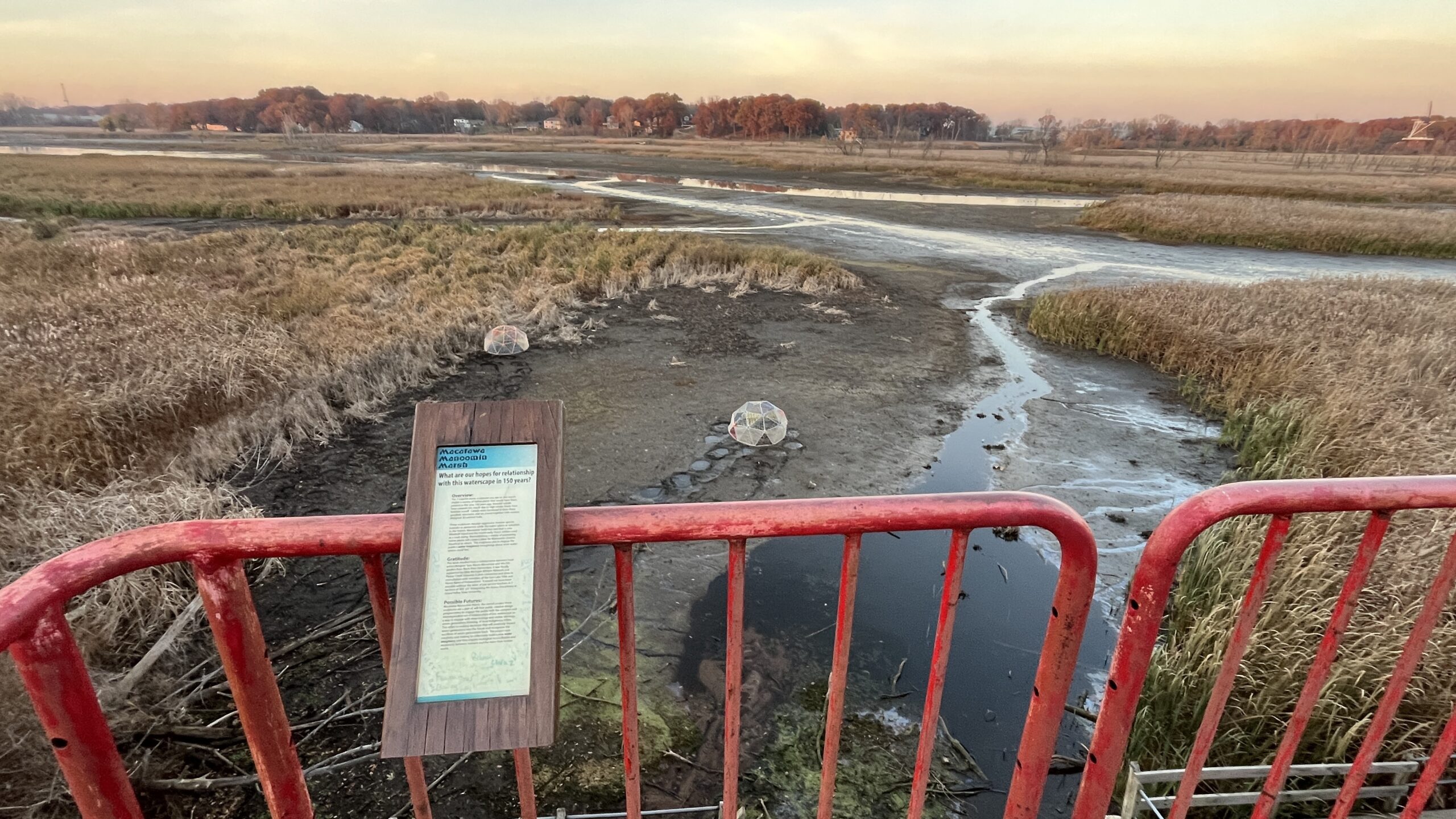


Overview:
The colorful dome sculptures you see on this marsh shelter a variety of native plants that would have been present in this area 150 years ago. Invasive cattails have covered this marsh due to high nitrate levels from fertilizer runoff. Cattails were harvested to form these geodesic structures and are joined together with custom designed 3D printed hubs.
These sculptures reassign aggressive invasive species (cattails) as protectors while the native plants re-establish in the historic Manoomin (wild rice) bed that is now Windmill Island and the marsh early Dutch settlers used as a trash dump. Reestablishing a variety of pioneering native plants will create a place for Manoomin (Zizania Aquatica) to return. The sculptures aim to engage the public’s water imaginary (imaginings about what water spaces could be).
Gratitude:
This work resulted from a collaboration between local artist+designer Sara Alsum-Wassenaar and 4th/5th graders from Black River Elementary. It was fiscally supported by West Michigan MiStem Network and Plaster Creek Stewards (Calvin University) and done in consultation with members of the Gun Lake Tribe and Huron Band of Pottawatomi. It would not have been possible without the labor of pre-service teachers in 3 sections of ART 231 (Integrating Art Across Disciplines) at Grand Valley State University.
Possible Futures:
Macatawa Manoomin Marsh, the overall project these sculptures are a part of, will host public creative design programming to engage the public with the complex and interdependent set of relationships of this waterscape as a way to engage with deep ecology and similar ideology, seven generations thinking, of local Indigenous tribes. This refers to making decisions that will positively impact seven generations into the future and recognizes the sacrifices of seven generations back. The project uses creativity and making to collectively build a new water imaginary, one that inspires ecological reconciliation and reciprocity between humans and the more than human world.